
How Long Does Nanoplastia Last? 3–6 Months, and What Changes It
Nanoplastia lasts 3 to 6 months. See the 4 factors that decide 3 vs 6, the home-care rules that add weeks, and when to book the touch-up.
Vitta Gold Academy · October 3, 2026 · 9 min read
Key takeaways
- Nanoplastia lasts 3 to 6 months, depending on hair type, technique and home care.
- Full processing time (40–60 min) and correct thermal sealing are what build durability.
- Sulfate-free home care and a planned touch-up keep the client near the six-month end.
- Nanoplastia reaches 100% straight on any hair type, and the finish — straight, anti-frizz natural or curl definition — can be adjusted without changing the expected duration range.
How long does Nanoplastia last? On average 3 to 6 months. The treatment works in the cortex and the cuticle, so the result fades gradually as the hair grows and is washed rather than washing out after a few weeks. Where each client lands in that window depends on her hair, on how the service was performed and on the products she uses at home.
Why does Nanoplastia fade gradually instead of all at once?
Nanoplastia does not sit on top of the hair like a styling product that rinses out in one wash. The active penetrates the cortex, where internal bonds are temporarily reorganised, and the flat-iron step seals that new alignment while the cuticle closes back over it. Because the change lives inside the fibre itself, it leaves the hair the same way hair always changes shape over time: through growth and through the slow mechanical and chemical wear of washing, heat styling and sun exposure. New growth at the root always reverts to the client's natural pattern from day one — that is not the treatment 'failing', it is simply untreated hair growing in. The treated lengths hold their shape far longer, which is why most clients experience the service as 'it lasted months' rather than 'it disappeared'.
What decides three months versus six?
| Factor | Pushes towards 3 months | Pushes towards 6 months |
|---|---|---|
| Processing time | Rinsed before 40 minutes | Full 40–60 minutes |
| Thermal sealing | Too few passes, low temperature | 10–20 passes per strand at the protocol temperature |
| Home care | Sulfate shampoo, daily washing | Sulfate-free shampoo and conditioner |
| Hair history | Untreated porosity, no diagnosis | Diagnosis-led dwell time and sections |
| Growth | Fast regrowth, very short cut | Longer hair where regrowth shows later |
None of these factors act alone. A client with fast hair growth and perfect home care will still need a root touch-up sooner than a client with slow growth, simply because the untreated regrowth becomes visually obvious at the root before the treated lengths show any real fading. This is why the appointment conversation should separate two different clocks: how long the treated hair itself holds its shape, and how soon the regrowth line becomes noticeable.
Does it work the same on every hair type?
Nanoplastia reaches 100% straight on any hair type, and the finish is adjustable: fully straight, a natural anti-frizz finish or defined curls. Durability follows the same rules on every texture. Coily and very resistant hair simply needs thinner sections and the full end of the processing window.
Fine, colour-treated and bleached hair durability is also governed by the same table above, but the professional usually works at the lower end of the temperature range and with fewer passes to protect the fibre — which does not shorten the expected 3–6 month window on its own, provided processing time and sectioning are correct. What shortens the window on compromised hair is skipping diagnosis, not the hair type itself.
How does Nanoplastia's duration compare to other smoothing services?
Clients frequently ask how Nanoplastia stacks up against keratin treatments or a blow-dry-only routine. Duration across smoothing categories varies enormously by formula and technique, which is exactly why the name on the bottle is a poor predictor of how long a result lasts. What is consistent is this: services that only coat the cuticle or rely on conditioning actives alone tend to wash out faster than services that act inside the cortex and are sealed with controlled heat, because there is simply less structural change to grow out of. Nanoplastia's 3–6 month range reflects a cortex-level change with a thermally sealed finish, which is why a technically correct service outlasts a rushed one from the same bottle.
What should the client do at home?
- Use a sulfate-free shampoo and the matching conditioner.
- Space out washes when possible; every wash is a small amount of wear.
- Use a heat protectant before blow-drying or flat ironing.
- Avoid prolonged chlorine or salt-water exposure without a protective rinse.
- Book the next appointment before leaving the salon.
What are the early warning signs that a result is fading faster than expected?
A frizz halo appearing within the first four to six weeks, a mid-length that reverts to wave before the root does, or a texture that feels coarser than the day it was done are all signs worth noting. They usually point back to one of two causes: the service itself was under-processed or under-sealed, or the client switched to a sulphate-heavy shampoo without realising its effect. Either way, the fix is not more heat at home — it is a diagnostic conversation at the next visit, and in some cases a partial reapplication sooner than the usual schedule.
When is the right time for a touch-up?
When the regrowth starts to show volume, usually between month three and month six. A touch-up on the regrowth keeps the lengths protected and the result even. It also turns a one-off service into a recurring client.
Does hair porosity by itself predict how long Nanoplastia will last?
Porosity affects how fast the active penetrates the cortex, but it is not, on its own, a reliable predictor of final duration. High-porosity hair absorbs the active quickly, which is exactly why it needs a careful strand test and often a shorter dwell time rather than the full upper end of the processing window — but once correctly processed and sealed, it can still hold a result for the same three-to-six-month range as low-porosity hair. The factor that actually separates a three-month result from a six-month one is whether the processing time and thermal sealing were matched to that porosity reading, not the porosity reading itself. Treating 'high porosity' as an automatic reason to expect a shorter result, without adjusting the protocol, is a missed opportunity rather than an unavoidable outcome.
Should a client change her routine in the weeks right before a touch-up?
In the final few weeks before a scheduled touch-up, some stylists advise easing off daily heat styling and leaning more on the aftercare products rather than introducing anything new. This is less about extending the current result — by that point the regrowth is already visible and driving the decision to rebook — and more about arriving at the touch-up appointment with hair in a known, stable condition rather than one affected by a newly tried product or a different heat tool. A consistent routine in the run-up to the appointment also makes it easier for the stylist to judge, at the diagnosis stage, how the treated lengths actually held up versus how a styling change might have masked or exaggerated fading.
Sources
- American Academy of Dermatology — Healthy hair care and heat-styling guidance
- Hair Cosmetics: An Overview — International Journal of Trichology (NIH/PMC) — Hair structure, cosmetic chemistry and how treatments act on the fibre
- StatPearls — National Library of Medicine — Anatomy and physiology of the hair fibre
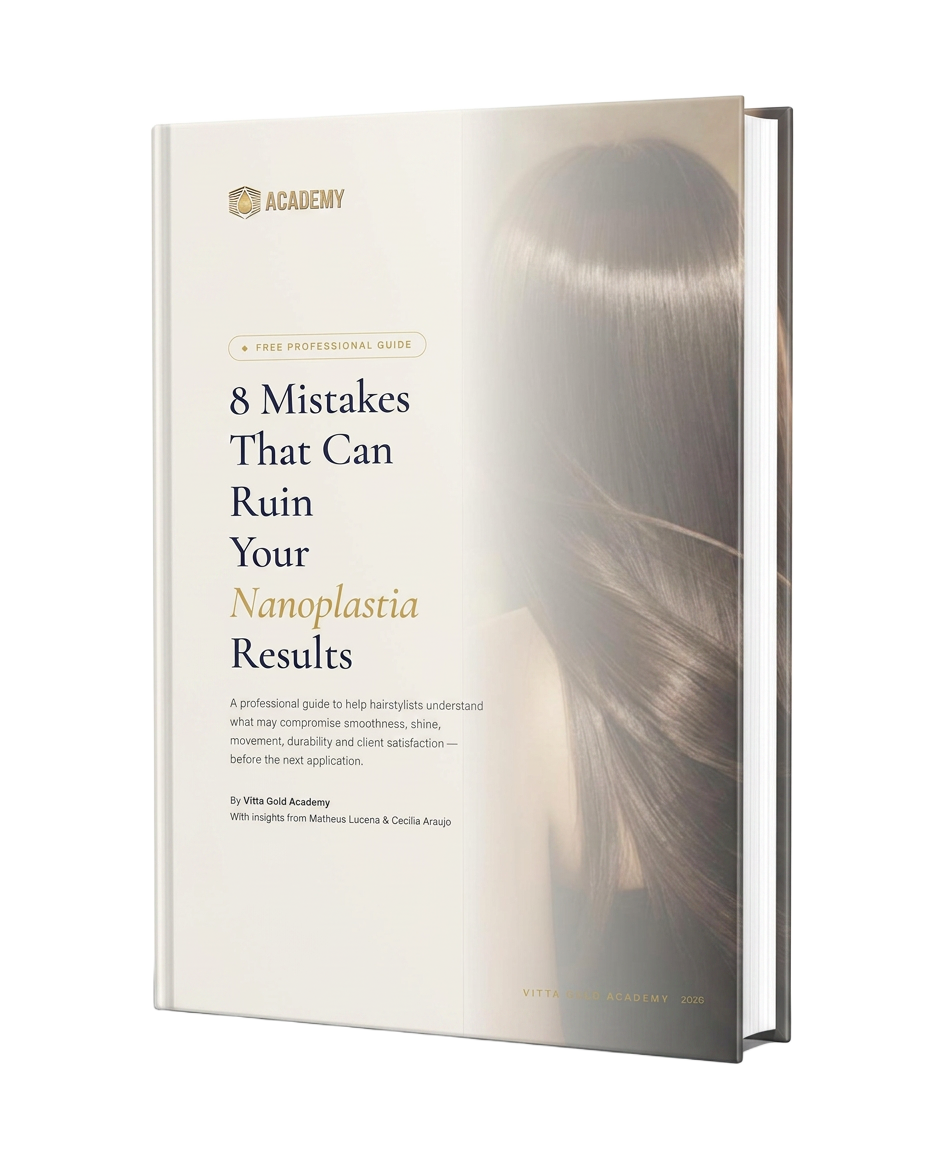
Free for professionals
8 Mistakes That Can Ruin Your Nanoplastia Results
The technical and commercial errors behind most failed services — skipped diagnosis, thick sectioning, improvised heat, weak aftercare and pricing that destroys your hourly rate — with the checklist to prevent each one.
Download the free guideFrequently asked questions
How long does Nanoplastia last?
Between 3 and 6 months, depending on hair type, technique and home care.
Why did my client's result drop after a few weeks?
The most common technical cause is rinsing before the 40–60 minute processing time or skipping the thermal sealing passes.
Can I repeat Nanoplastia?
Yes. A touch-up on the regrowth every 3 to 6 months keeps the result even.
Does washing remove Nanoplastia?
No. It fades gradually; sulfate-free products slow that down.
Does Nanoplastia last a different amount of time depending on the finish chosen?
The underlying structural change lasts the same 3–6 months regardless of finish. A fully straight result shows regrowth more visibly as hair grows out, while an anti-frizz natural finish or curl definition tends to blend with new growth for longer.
Does hair type change how long Nanoplastia lasts?
Not on its own. Nanoplastia reaches 100% straight on any hair type, and durability depends far more on correct processing time, sectioning and home care than on whether the hair is fine, coily, coloured or virgin.
Can a client speed up fading by over-washing?
Yes. Frequent washing, especially with a sulfate shampoo, is one of the fastest ways to shorten the result, because each wash mechanically and chemically wears at the sealed cuticle.
Does high porosity automatically mean a shorter-lasting result?
Not on its own. High porosity means the active penetrates faster and the protocol should be adjusted accordingly, but once correctly processed and sealed, high-porosity hair can still fall within the same 3–6 month range as any other hair type.