
Nanoplastia Processing Time: Why 40–60 Minutes, and What Changes It
Leave Nanoplastia on for 40–60 minutes. What decides 40 vs 60 by hair type, why 20 minutes fails, and what happens when it is rinsed too early.
Vitta Gold Academy · September 17, 2026 · 9 min read
Key takeaways
- Processing time is 40 to 60 minutes; the reaction is chemical, not visual, and happens in both the cortex and the cuticle.
- Porosity, density, curl pattern and chemical history move the time inside that window, never below it.
- Rinsing early is the most common cause of a result that drops in weeks instead of the usual 3 to 6 months.
- Nanoplastia reaches 100% straight on any hair type when processing and sealing are both complete — the window is non-negotiable, only the finish is a choice.
How long does Nanoplastia stay on the hair? Between 40 and 60 minutes. That window is the time the actives need to penetrate the cuticle, work through the cortex and reorganise the fibre's internal bonds before drying and thermal sealing. The reaction is chemical, not visual — hair that already looks smooth in the bowl at minute 20 is not hair that has finished processing, and treating it as finished is the single most common technical mistake in the service.
What is the processing time actually doing to the hair?
Nanoplastia does not sit on top of the hair the way a conditioning mask does. The active has to cross the cuticle, move into the cortex, and have enough time there to rebuild the internal bonds that determine the fibre's shape. Cutting that window short does not produce 'a lighter version' of the result — it produces a result where the surface has been smoothed by heat and product residue while the internal structure was never actually reorganised, which is exactly why it reverts quickly.
What the clock is doing, minute by minute
- Minutes 0–15: the actives migrate past the open cuticle into the cortex.
- Minutes 15–40: the internal bonds reorganise; this is where durability is built.
- Minutes 40–60: the reaction completes evenly across zones of different porosity, including resistant regrowth and more porous mid-lengths on the same head.
What moves the time inside the window?
| Factor | Effect on time |
|---|---|
| High porosity, previously bleached | Nearer 40 minutes, watched closely |
| Virgin, resistant hair | Nearer 60 minutes |
| Very dense or coily hair | Nearer 60 minutes, with thinner sections |
| Fine, low-density hair | Nearer 40 minutes, monitored for elasticity |
| Cool salon environment | Add time rather than heat, unless the protocol allows it |
None of these factors justify going under 40 minutes. They only decide where, inside the 40–60 minute range, a particular head of hair sits. A stylist who has diagnosed porosity, density and chemical history correctly should already know, before the timer starts, roughly where in that window they expect to land — and should still check the fibre rather than trusting the prediction blindly.
Does hair length or amount of hair change the processing time?
Length and overall volume of hair change how long application takes, not how long the product needs to process once it is on. A long, dense head takes longer to section and apply to, which is why total appointment time stretches on long hair — but once the last section is saturated, the 40–60 minute clock for that section still runs on the same chemistry. This is also why starting application at the most resistant, densest area matters: it gives that section the longest possible exposure inside the window by the time you reach the last strand.
Can you shorten processing time by raising the room temperature or using a heated cap?
Only if the manufacturer's protocol explicitly allows it. Some professional systems include a specified accelerator step using controlled heat during processing; outside of that specification, adding ambient heat or a heated cap to 'speed things along' changes the reaction in ways that are not documented and not predictable strand to strand. Follow the written protocol for the line you use rather than improvising a shortcut, especially on a step that is already the most common point of failure in the service.
What happens if you rinse too early?
You get a result that looks correct on the day and collapses in weeks. The surface behaves, the cortex was never fully reorganised, and the client returns disappointed inside a month — a redo that costs you a full chair, a product refill and, often, the client's trust in the service altogether. Early rinsing is the most common technical reason for a Nanoplastia that does not last the expected 3 to 6 months.
Where does the rest of the appointment go?
- 1Diagnosis and strand test: 10–15 minutes.
- 2Deep cleansing with a cuticle-opening pre-treatment: 10–15 minutes.
- 3Application, strand by strand: 20–40 minutes depending on length and density.
- 4Processing: 40–60 minutes.
- 5Complete drying: 15–25 minutes.
- 6Controlled thermal sealing and finishing: 30–45 minutes.
Price the appointment, not the processing. Two to three hours of chair time is the real cost of the service, which is why pricing per hair length and density protects your margin far better than pricing around the 40–60 minute window alone.
Does processing time affect which finish you can deliver?
Yes, together with the thermal sealing step. Full processing inside the 40–60 minute window plus complete sealing on every strand is what allows a 100% straight, mirror-smooth finish on any hair type, including coarse and highly resistant textures. Choosing a lighter finish — natural anti-frizz or defined curls — is a decision made at consultation and executed mainly through the sealing step and finishing technique, not by shortening the chemical processing window itself.
What about resistant grey hair?
Grey and white hair is frequently more resistant than the surrounding pigmented hair on the same head, with a thicker cuticle and lower porosity in many clients. That resistance pushes processing time towards the 60-minute end of the window and often calls for thinner sections specifically in the grey zones, rather than a different product altogether. Treating a head with mixed grey coverage as a single uniform processing time is a common reason for patchy results where pigmented hair reaches 100% straight and grey panels only partially respond.
How does processing time interact with the rest of the protocol?
Processing time does not work in isolation — it is one of several load-bearing steps alongside sectioning, moisture level at application and thermal sealing. Thin sections make the 40–60 minute window more effective because heat and product reach every strand evenly; thick sections can make even a full 60 minutes of processing uneven, because the actives penetrate the outer layers of the section faster than the inner ones. The full execution sequence, including how sectioning and thermal activation interact with processing time, is covered step by step in our protocol guide.
How do you monitor processing without guessing?
Check small test strands at intervals rather than relying only on the overall clock, especially past the 40-minute mark on hair with mixed porosity. The fibre should feel aligned and pliable when gently stretched, never slippery, gummy or elastic. Elastic, stretchy behaviour at any point during processing is a stop signal, not a 'needs a bit more time' signal — it means the fibre is already compromised and needs rinsing and a reconstruction step, not more exposure.
What does an under-processed result look like weeks later?
Clients describe it as 'it worked great for the first two weeks and then went back to how it was.' That pattern — fast reversion rather than gradual fading — is the signature of under-processing or incomplete thermal sealing, and it is almost always traceable to a shortened processing window, thick sections that blocked even heat, or both together. A correctly processed and sealed Nanoplastia fades gradually over 3 to 6 months as the hair grows, it does not collapse within weeks.
Sources
- Hair Cosmetics: An Overview — International Journal of Trichology (NIH/PMC) — Hair structure, cosmetic chemistry and how treatments act on the fibre
- StatPearls — National Library of Medicine — Anatomy and physiology of the hair fibre
- U.S. Occupational Safety and Health Administration — Occupational safety guidance for hair salons and smoothing services
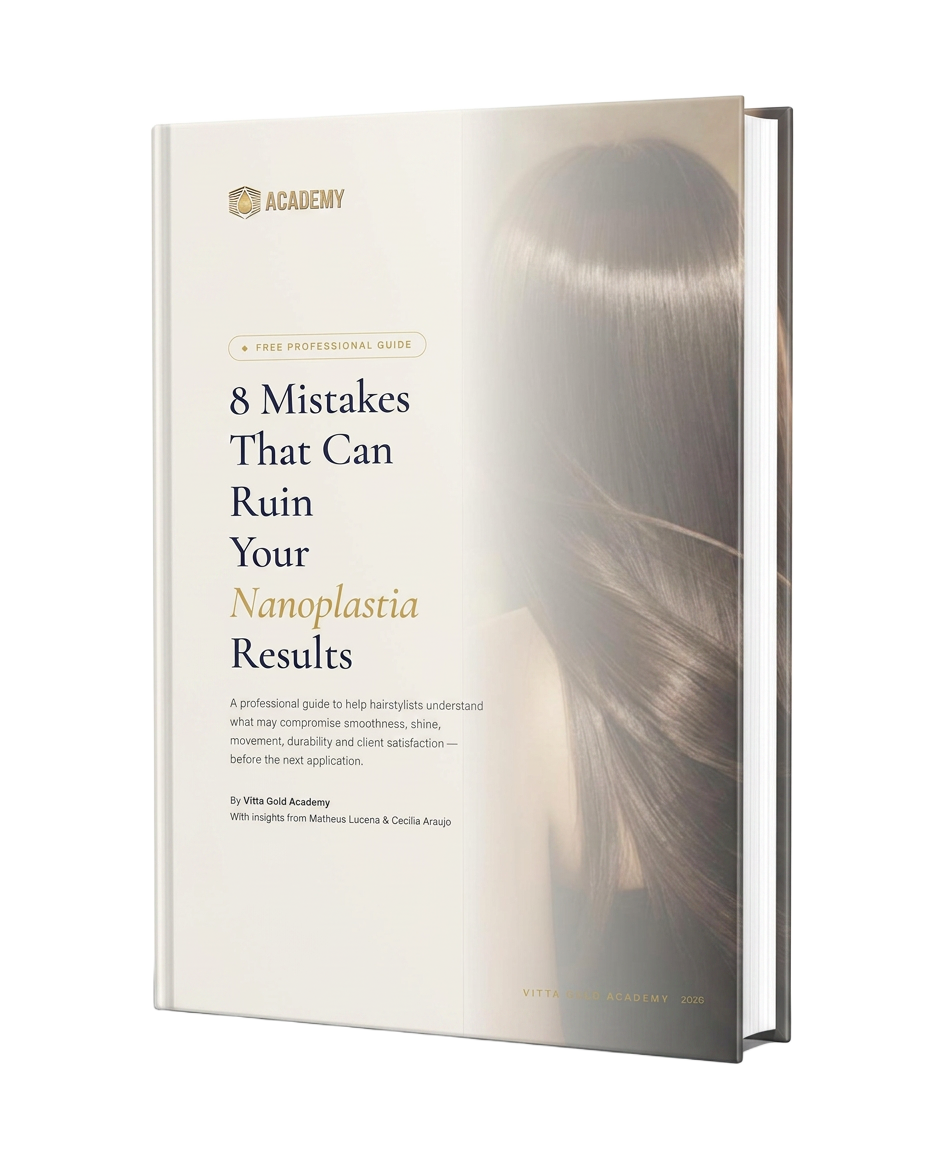
Free for professionals
8 Mistakes That Can Ruin Your Nanoplastia Results
The technical and commercial errors behind most failed services — skipped diagnosis, thick sectioning, improvised heat, weak aftercare and pricing that destroys your hourly rate — with the checklist to prevent each one.
Download the free guideFrequently asked questions
How long does Nanoplastia stay on the hair?
Processing time is 40 to 60 minutes. The actives need that window to penetrate the cuticle, work through the cortex and reorganise the fibre before complete drying and controlled thermal sealing.
Can Nanoplastia be done in 20 minutes?
No. A twenty-minute pause is not enough for the chemical reaction to complete in the cortex, and the result drops within weeks instead of lasting the usual 3 to 6 months.
How long is the full appointment?
Roughly two to three hours including diagnosis, deep cleansing, application, 40 to 60 minutes of processing, complete drying and thermal sealing.
Does bleached hair process faster?
Higher porosity generally sits nearer the 40-minute end of the window and needs closer monitoring, but the window itself does not change — it is never shortened below 40 minutes.
What should the hair feel like when processing is finished?
Aligned and pliable when gently stretched. Slippery, gummy or elastic behaviour means the fibre is compromised, not ready — rinse and reconstruct rather than continuing to the iron.
Does a longer processing time guarantee a straighter result?
No. Staying within the 40–60 minute range matters far more than pushing past it. The finish — 100% straight, anti-frizz natural or curl definition — is controlled mainly through sectioning and thermal sealing, not by extending processing beyond the specified range.
Why did my client's Nanoplastia revert within two weeks instead of lasting months?
Fast reversion, as opposed to gradual fading, points to under-processing or incomplete thermal sealing — most often a processing time cut short or sections that were too thick to heat evenly.